
The short answer: By the time a brown stain blooms on your ceiling, water has usually been inside the roof system for weeks — sometimes months. The earliest roof leak signs in Miami homes are subtler: granules collecting in gutters, a musty smell after summer storms, lifted or slipped tiles you can spot from the driveway, dark streaks on attic plywood, and paint bubbling near crown molding. In 2026, Canopy Roofing leak repairs in Miami-Dade and Broward start at $1,500 — the final number depends on where the leak is and how much damage it has already done. The same leak ignored through a wet season routinely climbs several thousand dollars higher once decking, insulation, and drywall are involved.
Why Miami Roof Leaks Hide Longer Than You’d Expect
South Florida roofs are built with multiple water-shedding layers — tile or shingle on top, underlayment beneath, then the deck. That redundancy is great in a storm and terrible for early detection: the covering can fail months before the underlayment finally lets water through, and even then, water travels along rafters and trusses before it drips. The spot on your ceiling is almost never directly under the hole. That travel time is your enemy — wood rots, insulation compacts, and mold gets established in our humidity within 24 to 48 hours of material getting wet.
So don’t wait for the stain. Here are the ten signs we tell homeowners to watch for, roughly in the order they usually appear.
The 10 Early Warning Signs
1. Granules in gutters and downspout splash zones
Asphalt shingles shed their protective granules as UV breaks them down. A sandy buildup in gutters or a dark “shadow” on the driveway below a downspout means the shingles are aging fast — and bald shingles leak next.
2. Slipped, cracked, or lifted tiles visible from the ground
Walk your property line after any strong storm and sight along the roof planes. A tile out of line by an inch exposes the underlayment beneath it to direct sun and rain, and that membrane was never meant to be the primary barrier for long.
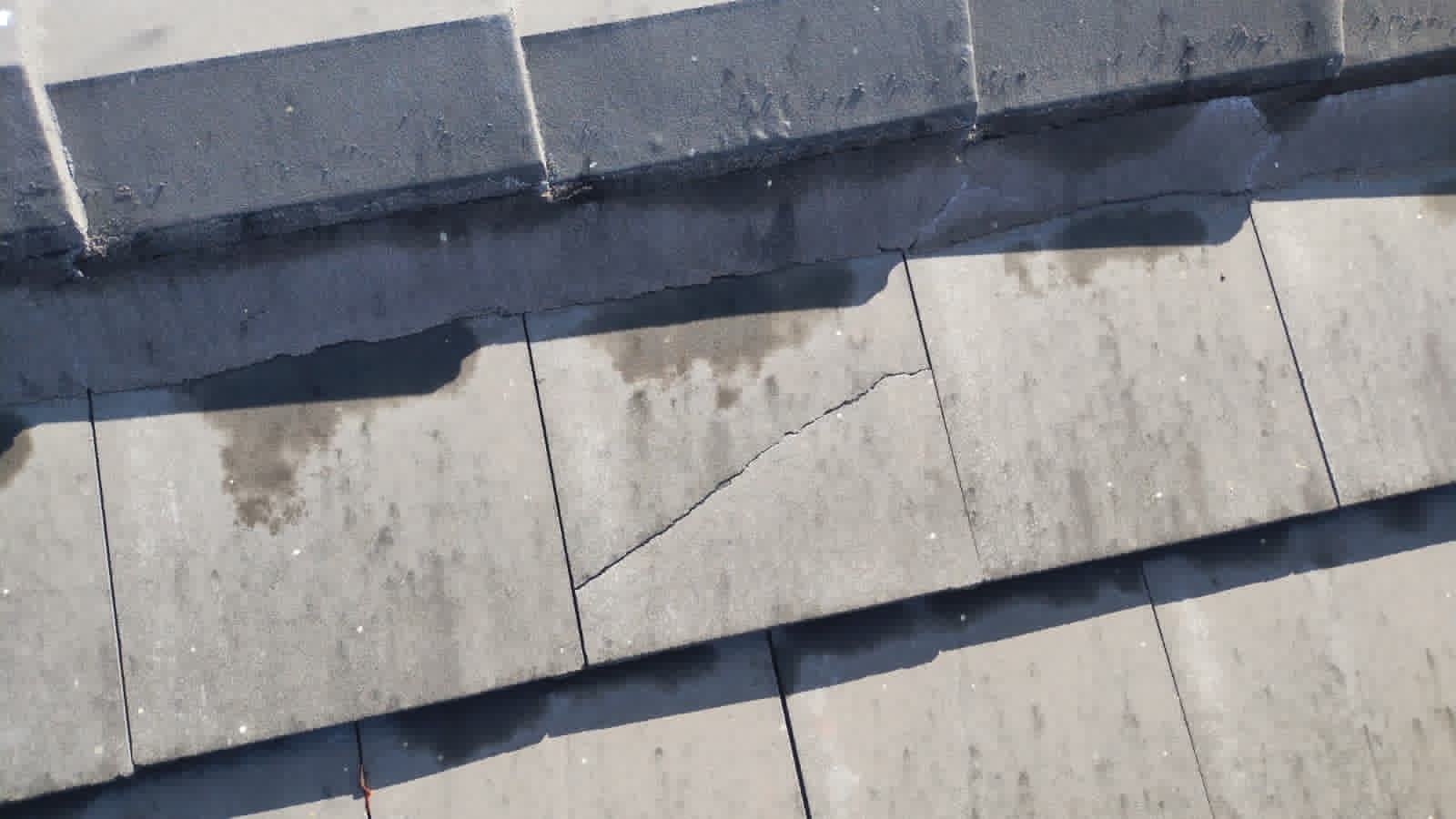
A single cracked tile. The dark staining around it is water already reaching the underlayment.
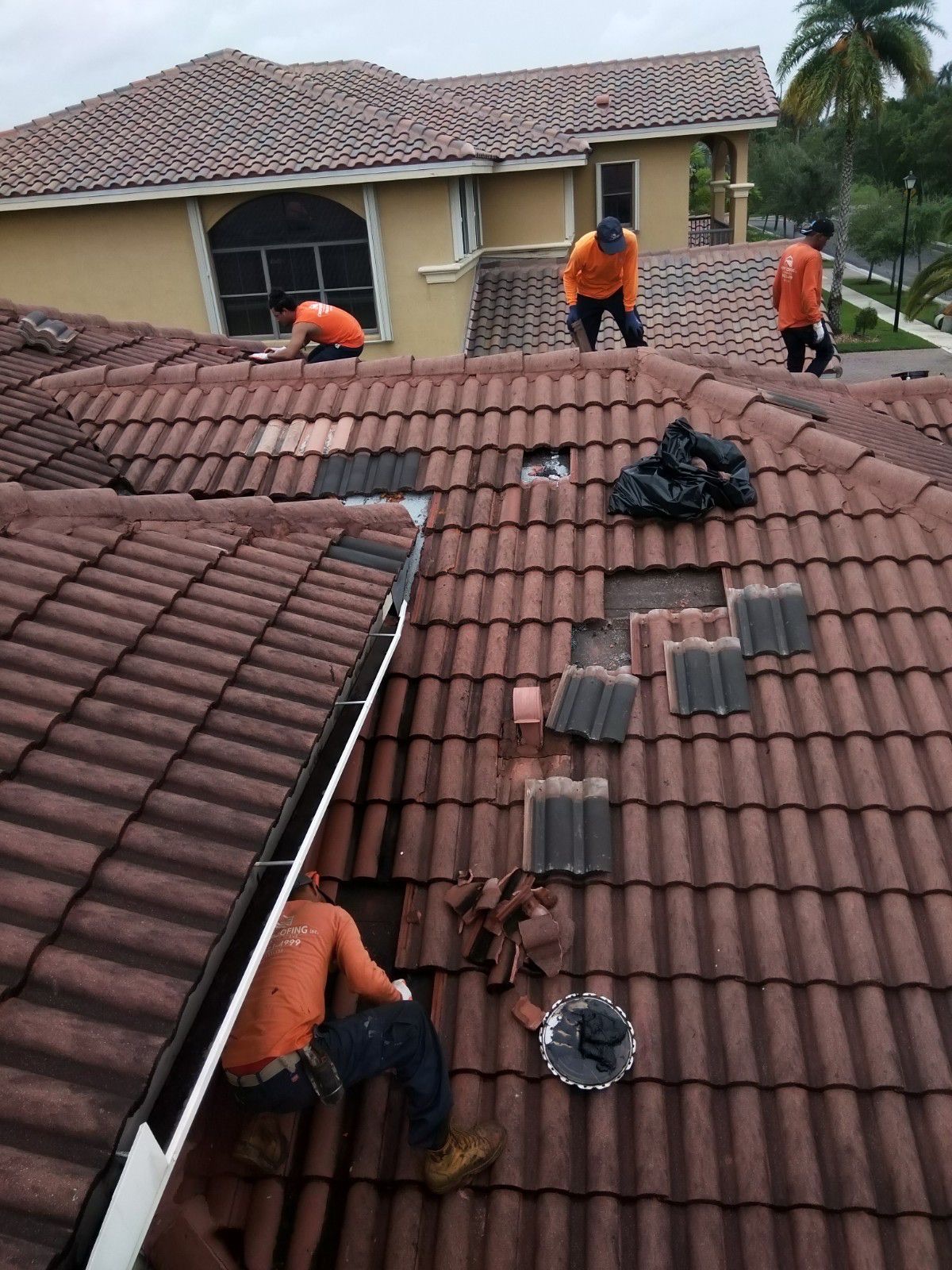
Canopy Roofing crew replacing broken tiles — caught at this stage, the fix stays on the surface.
3. A musty smell after rain — before you see anything
Your nose beats your eyes here. A damp, earthy odor in a hallway, closet, or room corner within a day of heavy rain means moisture is getting into materials somewhere above.
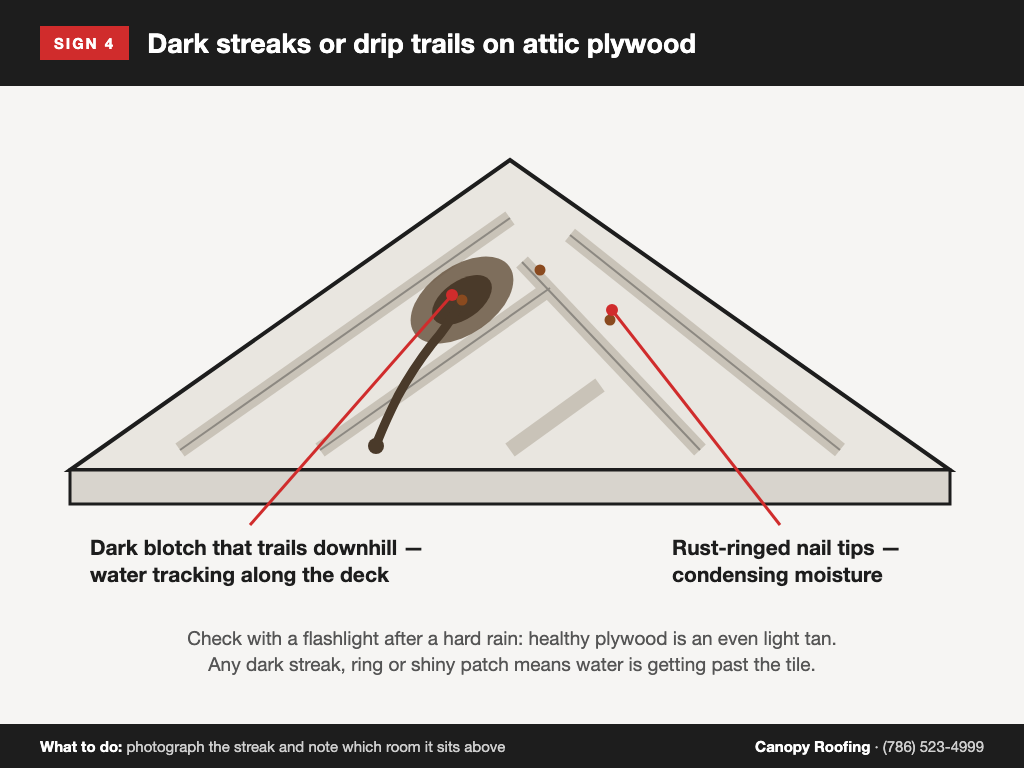
4. Dark streaks or drip trails on attic plywood
Ten minutes with a flashlight after a storm is the single best leak check available to a homeowner. Look for darkened wood, rusty nail tips, matted insulation, or shiny wet trails along rafters — especially around penetrations: vents, pipes, skylights, and the chimney.
5. Paint bubbling, peeling, or “sweating” near ceiling lines
Moisture migrating through drywall pushes paint off from behind. Small bubbles at crown molding or the top of a wall often show up well before a classic ceiling stain.
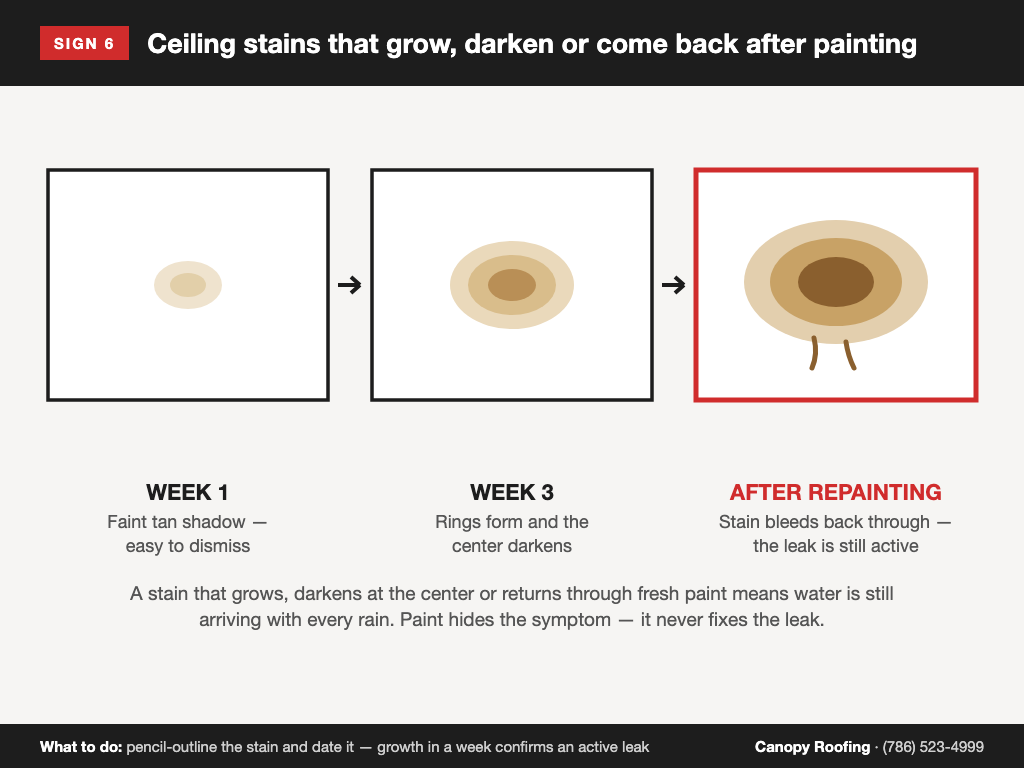
6. Ceiling stains that grow, darken, or come back after painting
A stain the size of a coffee cup that hasn’t changed in a year may be an old, fixed leak. One with a darker ring, a yellowing edge, or one that returns through fresh paint is active. Ring patterns mean repeat wetting — every storm adds a ring, like tree growth in reverse.
7. Rust streaks on the chimney or stains around it
Chimneys are their own leak system — cap, chase cover, crown, and flashing all age together. Rust streaks running down the chimney sides or a stain on the ceiling near the fireplace are chimney-assembly failures more often than roof-covering failures. Our chimney cap guide breaks down which part is leaking and what each fix costs.
8. Daylight or pinholes visible in the attic
Turn the attic lights off on a bright day. Any daylight through the deck (other than at proper vents) is a direct water path. Pinholes around nail penetrations count — capillary action pulls water through openings wind can’t.
9. Sagging gutter lines or fascia discoloration
When the roof edge stays wet — from wind-driven rain getting under the starter course or a failed drip edge — fascia boards stain, swell, and let gutters pull loose. Edge leaks are cheap to fix early and expensive after the fascia and sub-fascia rot.
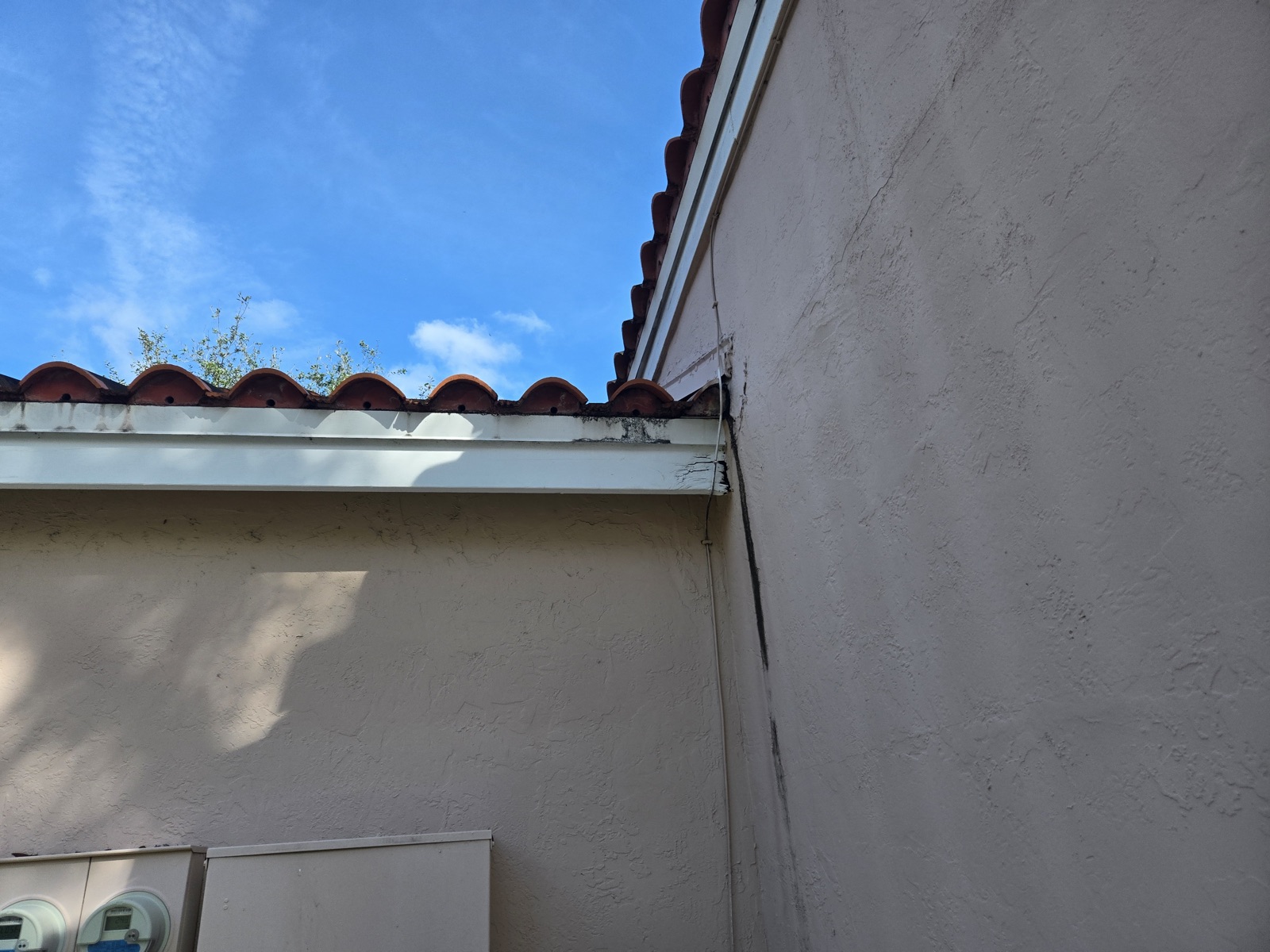
Rotted fascia at the roof edge. The staining on the wall below shows water has been running behind it for a while.
10. Higher humidity indoors and AC running longer
Wet insulation loses R-value, and moisture load makes your AC work harder. A room that suddenly feels clammier than the rest of the house can be the first measurable symptom of a roof problem you can’t see yet.
What a Roof Leak Repair Costs in Miami (2026)
Our minimum roof leak repair is $1,500. That covers finding the entry point, opening the area, fixing it properly, and closing it back up to code. From there, the price depends on where the leak is and how much damage it has already done. Here is what moves the number:
| Factor | How it changes the price |
|---|---|
| Where the leak is | A pipe boot or single tile in an easy-access area is the low end; a valley, wall flashing, chimney, or a spot over a vaulted ceiling takes more time and material. |
| How far the water traveled | If the underlayment is still dry, the repair stays on the surface. Once it is breached, we tear off and re-lay that section. |
| Decking condition | Wet or rotted plywood has to be cut out and replaced before anything goes back on — every sheet adds cost. |
| Material matching | Discontinued tile profiles, specialty metal, or custom flashing take sourcing time or fabrication. |
| Roof pitch and access | Steep pitches, two-story eaves, and tight lot lines need extra safety setup. |
| Interior damage | Insulation, drywall, and paint are separate from the roof work and scale with how long the leak ran. |
The pattern is the point: every layer water reaches adds to the bill, and the cheapest repair is always the one caught while it is still a covering problem and not a decking problem. We give you a written quote with photos before any work starts — details on how we scope and price are on our Miami roof repair page.
Seeing one of these ten signs?
A free inspection with photos tells you exactly what’s happening and what it costs to stop — before the next rain band adds a ring to that stain.
Miami-Dade: (786) 523-4999 · Broward: (754) 331-1561
Where Leaks Actually Start on South Florida Roofs
Roofs rarely leak in the middle of an open field of tile or shingle. They leak at transitions and penetrations — the places where two materials meet and a sealant or flashing does the work:
- Pipe boots and vents. The rubber collar around plumbing vents dry-rots in Miami sun in 8–12 years — the #1 source of “mystery” leaks we find.
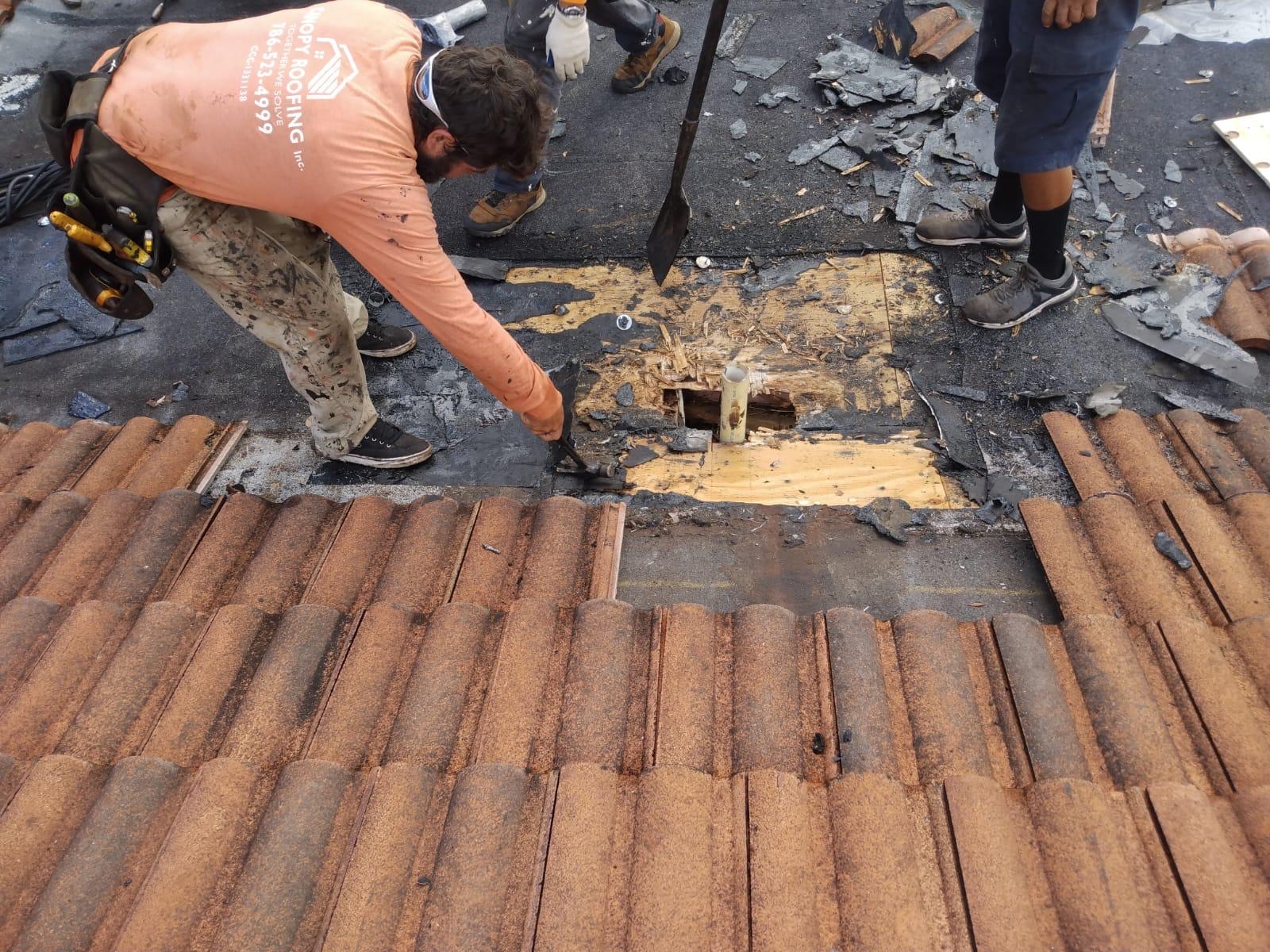
A leak at a lead stack. The tiles around it were intact — the failure was the boot itself.
- Wall and step flashing. Where a roof meets a wall, the flashing carries water past the joint. When it lifts, corrodes, or was never lapped right, water runs straight into the decking behind it — one of the most common leaks we open up.
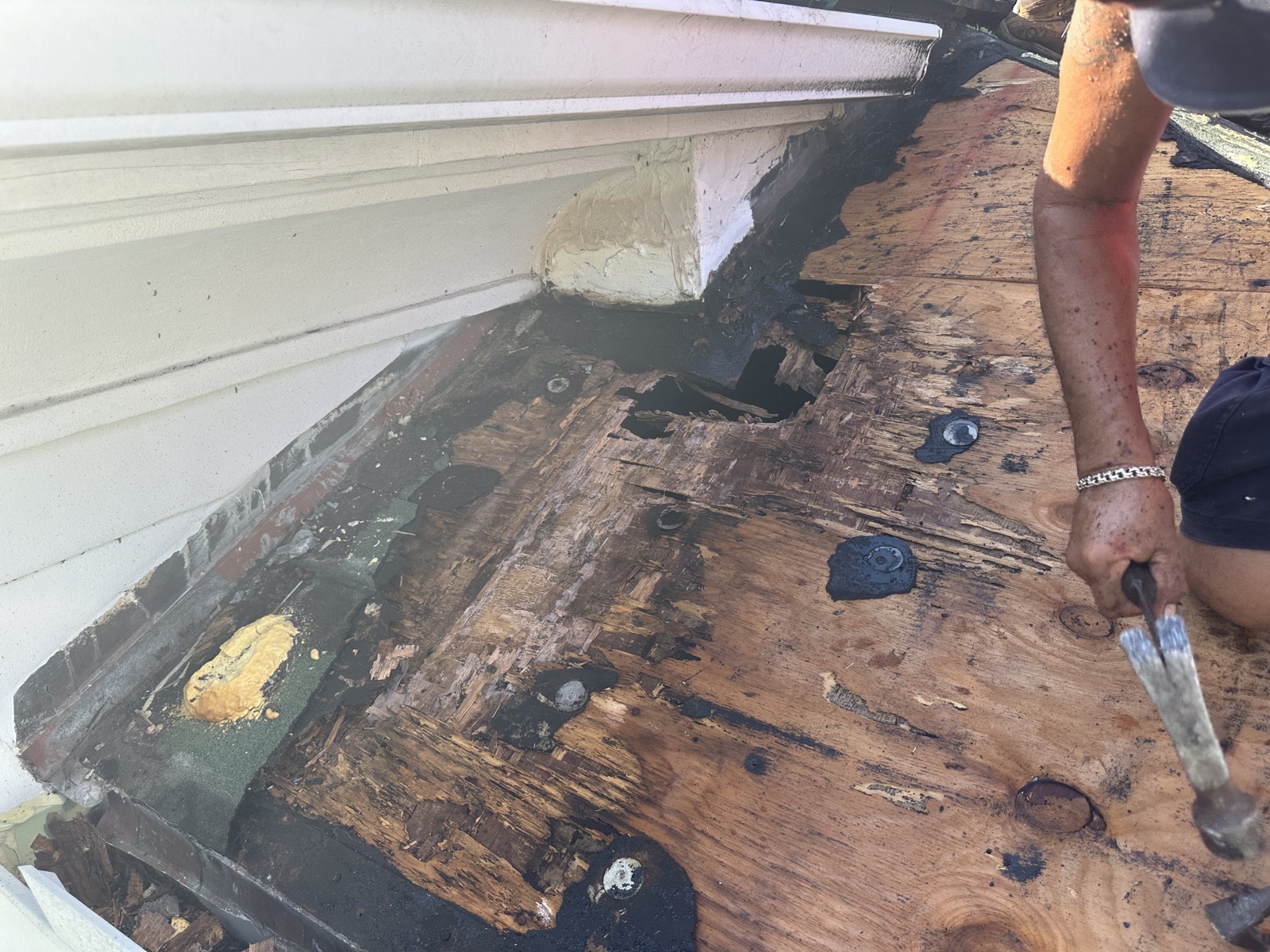
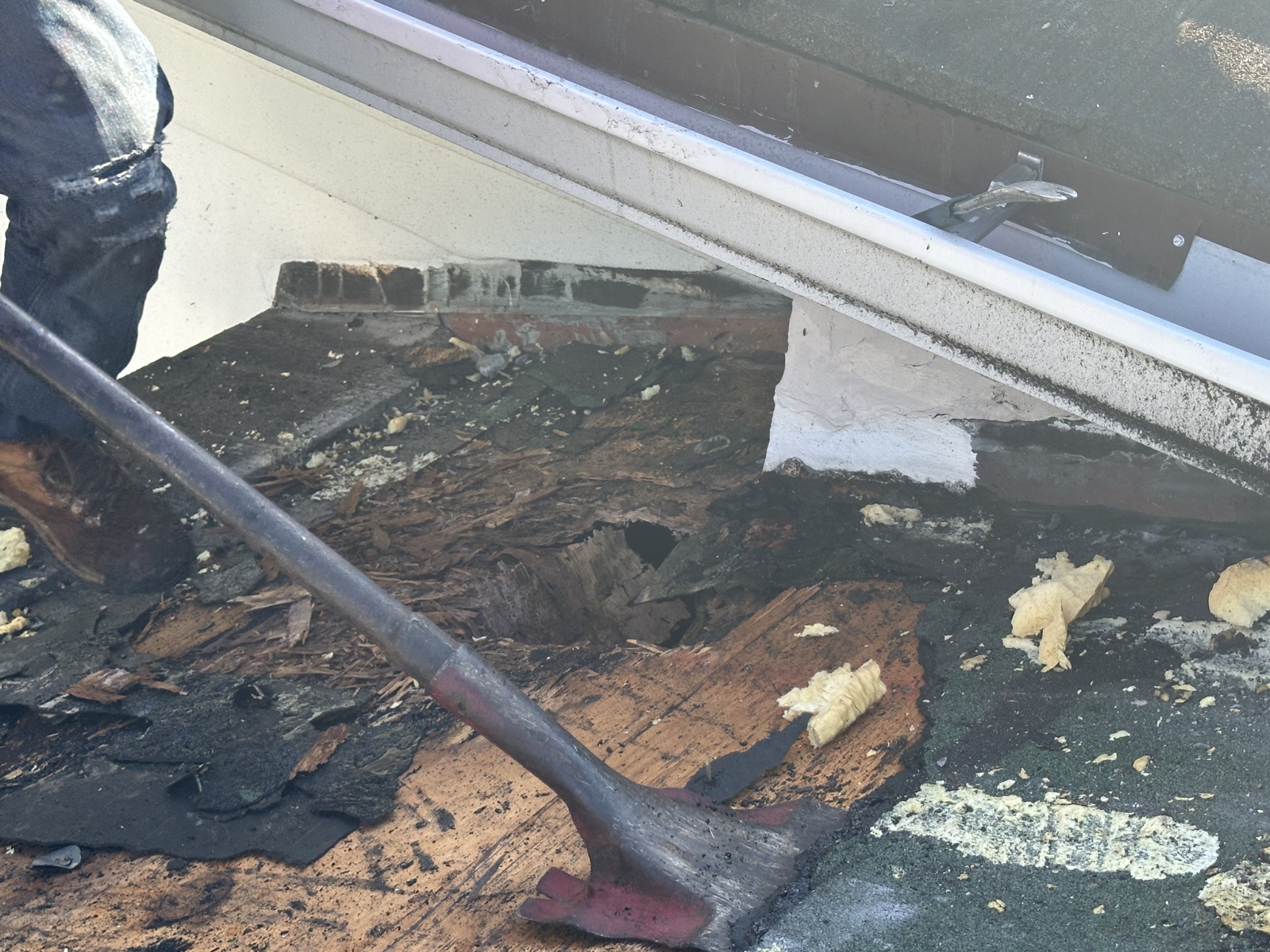
Two flashing leaks. In both, the covering looked fine from the ground — the decking underneath tells the real story.
- Chimneys and skylights. Multiple flashing joints, each one a candidate.
- Valleys. They carry the most water per square foot on the whole roof; debris dams in a valley push water sideways under the covering.
- Flat-to-slope transitions. Common on Miami additions and terraces — see our flat roof repair page for why ponding accelerates every failure mode.
On tile roofs, remember the tiles are the armor, not the raincoat — the underlayment beneath does the waterproofing, and it ages out at 20–25 years even under intact tile. Neighborhoods with 1990s–2000s tile like Doral and Pinecrest are right in that window now. If leaks are showing up in more than one room, read our breakdown of repair-vs-replacement signs — past a certain point, chasing individual leaks on a spent roof is the expensive path, and the roof replacement conversation (with financing if needed) is the honest one.
Where Canopy Roofing Works
Miami
Coral Gables
Pinecrest
Key Biscayne
Coconut Grove
Miami Beach
Miami Shores
Fort Lauderdale
Hollywood
Weston
Coral Springs
Plantation
Frequently Asked Questions
How do I know if my roof is leaking without seeing water?
Check the early indicators: granules collecting in gutters, a musty smell within a day of rain, paint bubbling near ceiling lines, and dark streaks or rusty nail tips on attic plywood. A ten-minute attic check with a flashlight after a heavy storm catches most leaks weeks before a ceiling stain appears.
What does the start of a roof leak look like on a ceiling?
It usually starts as a faint yellow or tan discoloration with a slightly darker edge, often near a wall, corner, or light fixture. An active leak grows, darkens, or forms rings after each storm; a stain that never changes may be from an old, already-fixed problem. Any stain that returns through fresh paint is active.
How much does roof leak repair cost in Miami in 2026?
Canopy Roofing leak repairs in Miami-Dade and Broward start at $1,500. The final price depends on where the leak is (a pipe boot is simpler than wall flashing or a valley) and how much damage the water has already done — a dry underlayment keeps it near the minimum, while wet decking, insulation, and drywall each add to it. We inspect free and quote in writing with photos before any work starts.
Why does my roof only leak during heavy rain?
Light rain sheds off the covering normally, but heavy or wind-driven rain overwhelms marginal spots: it works uphill under roof edges, backs up in debris-dammed valleys, and gets pushed through failing flashing. A leak that only appears in tropical downpours is still a real leak — it’s telling you which failure mode you have.
Can a roof leak fix itself or dry out on its own?
The interior materials can dry, but the entry point never closes on its own — every subsequent storm wets everything again, and in South Florida humidity, mold can establish within 24 to 48 hours of each wetting. A leak that “went away” during the dry season reliably returns in June.
The Bottom Line
Roof leaks announce themselves quietly long before they announce themselves expensively. Granules, smells, bubbling paint, attic streaks — each of those is the roof offering you the minimum-repair version of a problem that has a much more expensive version scheduled for later. Walk the property after storms, put a flashlight in the attic twice a year, and treat any change on a ceiling as information. Canopy Roofing inspects roofs across Miami-Dade and Broward free of charge and will show you photos of exactly what we find — including when the honest answer is that you’re fine. More South Florida roofing guides are on the Canopy Roofing blog.
Free Leak Inspection — Miami-Dade & Broward
Licensed, insured, HVHZ-compliant. We find the entry point, photograph it, and quote the fix in writing — usually same week.
Miami-Dade: (786) 523-4999 · Broward: (754) 331-1561