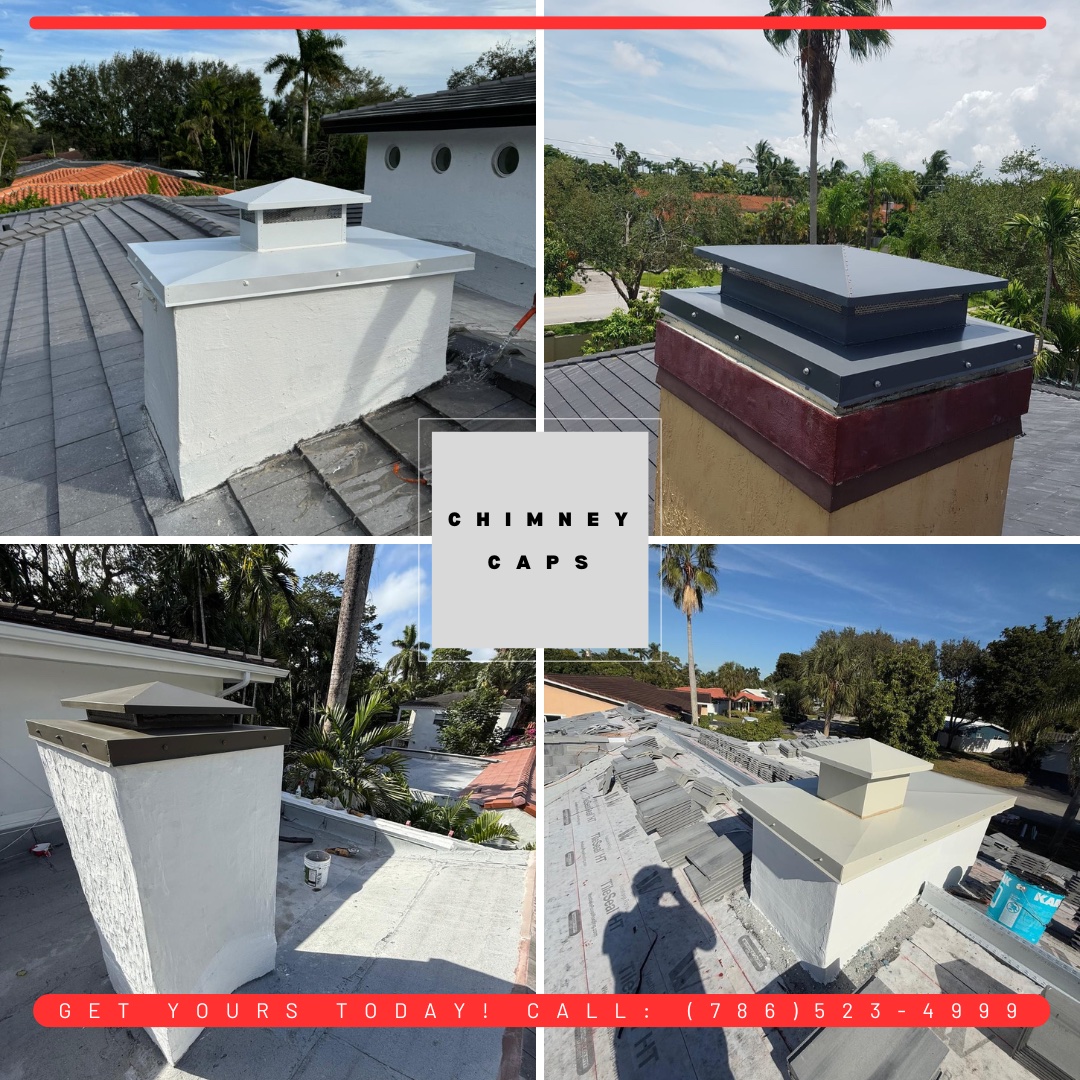
The short answer: A chimney cap in South Florida is primarily an aesthetic upgrade, not a leak repair. Canopy Roofing fabricates and installs custom chimney caps in galvalume or aluminum across Miami-Dade and Broward, and installed cost starts around $1,200 — nothing meaningful comes in under that, because the fabrication and the install labor, not the raw metal, drive the price. If you have an active leak around your chimney, the cap is almost never the cause: chimney flashing at the roofline is a separate assembly with a separate failure mode, and it needs a separate fix.
What a Chimney Cap Actually Does in South Florida
Up north, chimney caps are mostly about keeping sparks in and critters out. In Miami, the job description is different: our chimneys spend ten months a year getting hit by near-daily rain, salt air, and UV that destroys sealants — and then hurricane season asks the whole assembly to stay put in 150+ mph gusts. A properly built cap does a few things at once:
- Keeps rain out of the flue. An open or missing cap lets water run down the flue into the smoke chamber and firebox. That is a chimney problem, handled at the top of the chimney — not the same thing as a leak showing up in the ceiling next to it.
- Keeps animals and debris out. Raccoons, iguanas, and palm debris all treat an open flue as an invitation. Nests block draft and hold moisture against the metal.
- Finishes the roofline. This is the honest main reason most South Florida homeowners buy one. A clean, custom-fabricated cap makes the chimney look intentional instead of unfinished — especially on a new roof.
- Resists uplift. In the High-Velocity Hurricane Zone, a loose cap becomes a projectile. Proper fastening into the chase or masonry — not just friction legs — is a code-level detail, not a nice-to-have.
The Upgrade Most Homeowners Never Think About
Here’s what we see on nearly every estimate: almost nobody plans for the chimney. Homeowners budget for the roof covering, the underlayment, the flashing, maybe the skylights — and the chimney cap never comes up as something to replace, maintain, or even look at during a roof replacement. Then the new roof goes on, and the old, sun-faded, mismatched cap is still sitting up there on top of it.
That’s why we usually bring it up as an add-on rather than a repair. If you’re already getting a new roof — and especially if you’re getting a metal roof — a matching chimney cap in the same metal and finish is a genuinely great touch. It’s one of the few small details that changes how the whole roofline reads from the street, and it costs a fraction of what it would cost to add later as its own trip, its own crew, and its own setup.
Chimney Cap Cost in Miami (2026)
Installed chimney caps in Miami-Dade and Broward start at roughly $1,200 and go up from there. You will see much lower numbers online — those are material-only prices for a box off a shelf, and they don’t reflect what it takes to get a cap fabricated to your chimney’s actual dimensions, lifted onto a roof, fastened to HVHZ standards, and sealed.
What moves the price is the install, not the metal: chimney size and shape, roof pitch and covering, height and access, whether the surrounding assembly needs work once we’re up there, and how much custom fabrication the finish requires. Two houses on the same block can price very differently.
On material, we build caps in galvalume or aluminum — both hold up well in South Florida’s salt air and can be finished to match a metal roof or the surrounding trim. For a real number on your house, the only honest path is someone on the roof with a tape measure and a camera: that’s what our free estimate covers.
Getting a new roof? Ask about a matching cap.
Custom-fabricated in galvalume or aluminum, finished to match — priced in while the crew is already on site.
Miami-Dade: (786) 523-4999 · Broward: (754) 331-1561
Chimney Caps and Chimney Flashing Are Two Different Things
This is the single most important distinction in this article, and it’s the one homeowners (and more than a few handymen) get wrong constantly.
A cap failure is not what causes a flashing leak. They are separate assemblies, in separate locations, that fail for separate reasons. A cap sits at the top of the chimney and deals with what falls into the flue. Flashing sits at the bottom, where the chimney passes through the roof covering, and deals with water running down the roof toward the chimney. Replacing a cap will not fix a flashing leak, and a perfect cap tells you nothing about the condition of the flashing six feet below it.
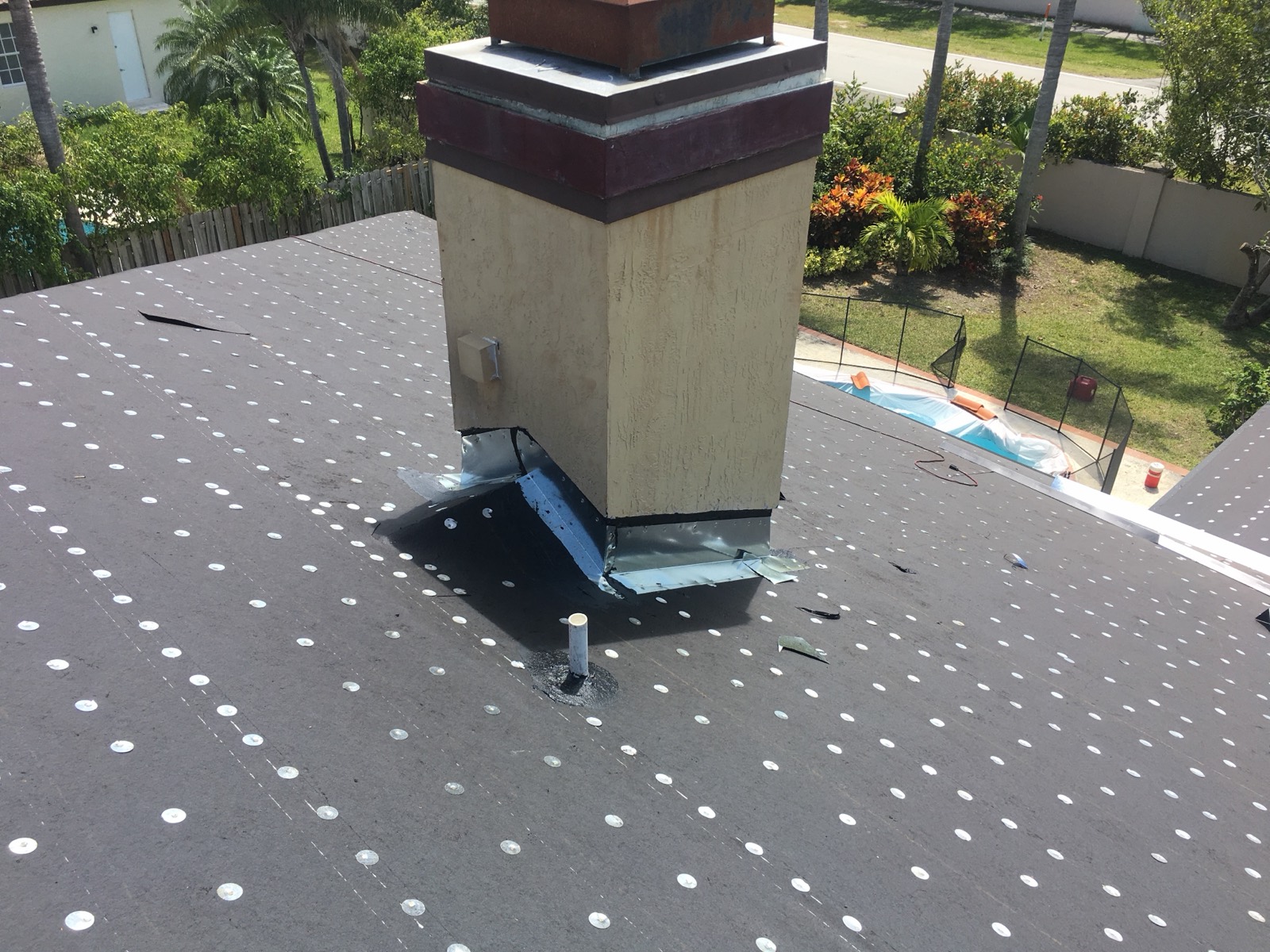
Chimney flashing: the metal transition where the chimney meets the roof covering. This is a different assembly from the cap at the top of the chimney, and it leaks for entirely different reasons.
How to tell which one you’re dealing with: if the water shows up inside the firebox — wet ash, a sharp ashy smell after heavy rain, staining in the smoke chamber — that points up top, at the flue. If the stain appears on the ceiling or wall next to the chimney, or runs down the chimney chase inside the house, that points at the flashing where the chimney meets the roof.
Flashing is also the harder, more expensive job of the two. It means opening up the roof covering around the chimney, and on tile roofs the surrounding tile has to come up and go back down. Homeowners in older tile neighborhoods like Coral Gables and Pinecrest see original 1990s flashing reaching end of life all over the area right now. If you have an active leak, start with Miami roof repair — not a cap.
Hurricane Season and the HVHZ Detail Most Installers Skip
Miami-Dade and Broward sit in Florida’s High-Velocity Hurricane Zone. That matters for chimney caps twice a year: once when a storm tries to remove the cap, and once when your insurance inspector photographs the roof. A cap held on by friction legs pushed into the flue is not attached in any meaningful sense — it’s stored up there. We through-fasten with corrosion-resistant hardware and seal every penetration, the same standard we hold on re-roofing work. After any named storm, add the chimney to your walk-around checklist: a shifted cap is easy to spot from the yard and cheap to re-secure before the next rain band arrives.
While you’re looking up, scan the rest of the roofline too — our guide to signs you need roof repair covers what else to check, and if the whole covering is at end of life, the roof replacement conversation is the honest one to have first. Flat-roofed homes with chimneys have their own detailing pattern — see our flat roof repair page.
Where Canopy Roofing Works
Miami
Coral Gables
Pinecrest
Key Biscayne
Coconut Grove
Miami Beach
Miami Shores
Fort Lauderdale
Hollywood
Weston
Coral Springs
Plantation
Frequently Asked Questions
How much does a chimney cap cost in Miami?
In 2026, an installed chimney cap in Miami-Dade or Broward starts at about $1,200 and goes up from there. Lower prices you find online are typically material-only figures for a stock cap. The variable is the installation — chimney dimensions, roof pitch and covering, access, and how much custom fabrication the finish requires — not the metal itself.
Does a chimney cap cause or fix a chimney flashing leak?
No. A chimney cap and chimney flashing are two different assemblies with two different jobs. The cap sits at the top of the chimney and keeps rain and animals out of the flue. The flashing sits at the roofline where the chimney passes through the roof covering. Flashing leaks are not caused by cap failure, and installing a new cap will not stop a flashing leak.
Is a chimney cap worth it if I’m not having a leak?
Usually yes, as an aesthetic and protective upgrade rather than a repair — and it’s the right time to do it if you’re already replacing the roof. Most homeowners never consider replacing or maintaining the chimney cap during a roof replacement, but a custom cap that matches the new roof finishes the roofline and costs far less when the crew is already on site.
What material should a chimney cap be in South Florida?
Galvalume or aluminum. Both hold up in South Florida’s salt air and UV, and both can be fabricated and finished to match a metal roof or existing trim. Canopy Roofing builds custom caps in these metals to each chimney’s actual dimensions rather than fitting a stock box.
Do chimney caps need to be hurricane rated in Miami?
Miami-Dade and Broward are in Florida’s High-Velocity Hurricane Zone, so chimney caps should be mechanically fastened with corrosion-resistant hardware — not held by friction legs alone. A loose cap can blow off in tropical-storm-force winds, leaving the flue open during the heaviest rain of the year and turning the cap itself into wind-borne debris.
The Bottom Line
A chimney cap is a finishing detail, and a good one: it keeps rain and animals out of the flue, it stands up to hurricane season when it’s fastened correctly, and it makes the chimney look like part of the roof instead of an afterthought. What it is not is a leak repair. If water is coming in around your chimney, that’s a flashing conversation, and it prices differently. Canopy Roofing fabricates custom chimney caps in galvalume and aluminum across Miami-Dade and Broward — and if you’re already planning a new roof, especially a metal one, that’s the moment to add a matching cap. More South Florida roofing guides are on the Canopy Roofing blog, and our financing options break bigger projects into monthly numbers.
Free Chimney & Roof Inspection — Miami-Dade & Broward
Licensed, insured, HVHZ-compliant. Photos of your cap and your flashing — and a straight answer on which one, if either, actually needs work.
Miami-Dade: (786) 523-4999 · Broward: (754) 331-1561